


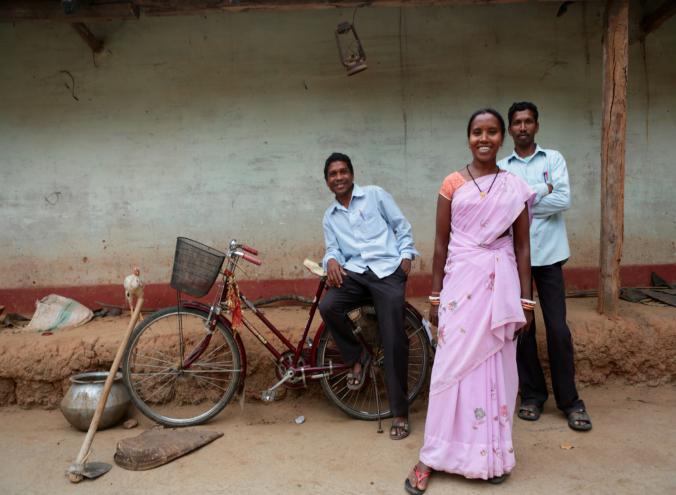
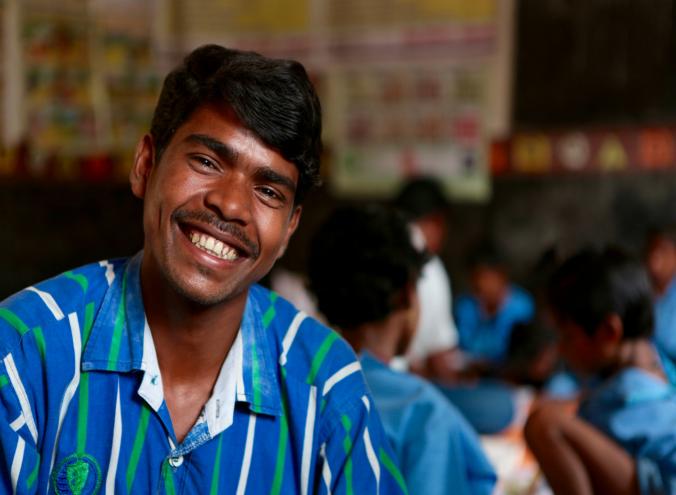
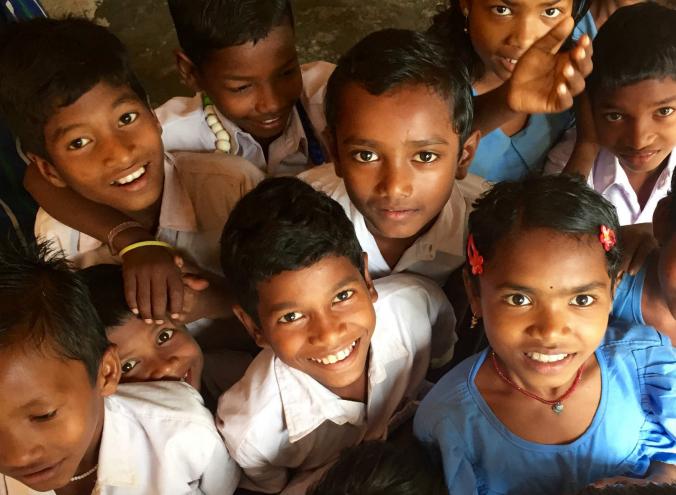
Oxfam India is promoting social inclusion and access to basic rights and entitlements to education, health, food and forest rights through building capacity of Community Led Organisations (CLOs) in nine tribal districts of Odisha. We are strengthening the thematic, advocacy and leadership capacities and skills of leaders of the CLOs so that these leaders of CLOs raise issues for policy dialogue. These CLOs are included in different district level advocacy processes through inclusion in district forest rights network, School Management Committee (SMC) network. We focus on engaging youth of excluded and marginalised groups in different ground and state level advocacy processes.
Here is a list of themes and organisations that Oxfam India works on in Odisha.
Essential Services
1) Sikshya Sandhan
Oxfam India and Sikshaya Sandhan work on using social accountability tools through community scorecard with mothers’ committee and jaanch (examination) committee of Integrated Child Development Services (ICDS). We also work for strengthening the discourse on education inequality through the state inequality report on education. At the ground level, we demonstrate a model on multi-lingual education. These apart, we build pressure on the government to facilitate inclusive and fair education through engaging media and legislators and strengthening Odisha Right To Education Forum at the state level as well as at district levels.
2) ADHAR
Oxfam India and ADHAR facilitate the formation of School Management Committees and Civil Society Organisation networks at the local level and facilitate for an effective dialogue with the state. We also work towards generating knowledge on the issue of accessibility of quality education and strengthening the grievance redressal system and train more people to demonstrate an active role in demand generation and grievance, addressing the access issue and improving the availability of schooling system that is universally providing opportunities to all.
3) Centre for Youth and Social Development (CYSD)
Oxfam India and CYSD work to disseminate the facts and evidence generated on health assurance and insurance programmes of government with the larger public and build narratives on health inequality. We are strengthening community monitoring mechanism through the implementation of social accountability tools in 30 villages of two districts and engaging government, CSO, networks and media for advocacy, influencing and campaign.
Economic Justice
1) Women’s Association for Socio-cultural Action (WOSCA)
Oxfam India works with the WOSCA in the 20 tribal villages of Keonjhar district for enabling communities to access Individual and Community Forest Rights. We build the capacity of the forest rights committees and district level network members on claiming processes and preparation of forest-based livelihood plan. The district and state level advocacy actions are undertaken through an interface with the district authorities on the issues of District Mineral Foundation.
2) Regional Centre for Development Cooperation (RCDC)
Oxfam India works with RCDC to strengthen the state network of Forest Rights Act in Odisha through generating evidence from the ground on the issues of violation of forest rights act and initiating advocacy with the state and district officials. In order to enable the tribal communities to enhance natural resource-based livelihood, we facilitate the communities to use renewable energy in the farm and forest-based activities.
Gender Justice
3) Indira Social Welfare Organisation (ISWO)
Oxfam India works with ISWO to prevent incidences of violence against women and girls especially domestic violence and ECFM (early, child and forced marriage) and to respond to the cases violence. Through establishing a women support centre in the premise of district police office in Dhenkanal, we provide counselling and other services such as linking survivors to avail medical, legal and shelter services offered by the government as well as other agencies. Oxfam India and ISWO are building capacities of young men and boys, adolescent girls on the issues of social norms that trigger gender-based violence in order to empower them to address such issues in their communities.
4) Institute for Social Development (ISD)
Oxfam India works with ISD to prevent incidences of violence against women and girls especially domestic violence and ECFM (early, child and forced marriage) and to respond to the cases violence. Oxfam India and ISD are building capacities of young men and boys, adolescent girls on the issues of social norms that trigger gender-based violence in order to empower them to address such issues. Oxfam India and ISD are empowering women to challenge social norms that trigger gender-based violence and to promote new norms that lead to gender equality.
5) Women’s Organisation for Rural Development (WORD)
Oxfam India and WORD work to respond to cases of gender-based violence and to link to survivors to avail different support services. Oxfam India and WORD are running 2 “Bijayini” women support centre from the premise of district police office in 2 districts namely Koraput and Rayagada to provide counselling and other services such as linking survivors to avail medical, legal and shelter services offered by the government as well as other agencies. We work to build the capacity of young men and boys in colleges on the social norms that trigger gender-based violence and to address these issues in the community.
6) National Alliance of Women’s Organisations (NAWO)
Oxfam India works with NAWO to prevent incidences of violence against women and girls especially domestic violence and ECFM (early, child and forced marriage) and to respond to the cases violence. Oxfam India and ISD are building capacities of young men and boys, adolescent girls on the issues of social norms that trigger gender-based violence in order to empower them to address such issues. Oxfam India and NAWO are empowering women to challenge social norms that trigger gender-based violence and to promote new norms that lead to gender equality. Oxfam India and NAWO are running “Bijayini” women support centres from the premise of district police office in 4 districts of Odisha namely, Kalahandi, Khordha, Nayagarh, Gajapati to provide counselling and other services such as linking survivors to avail medical, legal and shelter services offered by the government as well as other agencies.
Disaster Risk Reduction
1) SOLAR
Oxfam India has partnered with SOLAR to pilot resilient and sustainable models of community-based Disaster Risk Reduction in 10 highly flood and coastal disaster-prone villages of Puri district. At the local level the partnership is building the capacity of individuals and institutions - in taking informed and organised actions at different levels; and by taking leverage of existing scopes and potentials - on disaster preparedness, response, restoration and building-back-better. The partnership is supporting and leveraging government’s initiatives on search, rescue, relief and rehabilitation programmes through coordinated supplementary actions. The partnership is piloting an innovative Volunteer Network Management System (VNMS), an early warning and information exchange system, which has already networked 4,210 volunteers in 266 villages of 9 blocks in three disaster vulnerable districts, including Puri. The partnership is piloting innovative low-cost community managed models for safe water supply – including Iron and Salinity Removal filtration, sand-pond filter etc with energy supply from non-conventional and renewable sources that are propagated for replication at a government level. Oxfam India and Solar have a warehouse with boats and relief stocks which is enough to reach out to 2,000 households in quick time during disaster emergencies.
2) Pallishree
Oxfam India and Pallishree are piloting resilient and sustainable models of community-based Disaster Risk Reduction in 10 highly flood and coastal disaster-prone villages of Jajpur district in Brahmani river’s drainage delta. At the local level the partnership is building the capacity of individuals and institutions- in taking informed and organised actions at different levels; and by taking leverage of existing scopes and potentials - on disaster preparedness, response, restoration and building-back-better. The partnership is supporting and leveraging government’s initiatives on search, rescue, relief and rehabilitation programmes through coordinated supplementary actions. The partnership is piloting an innovative Volunteer Network Management System (VNMS), an early warning and information exchange system, which has already networked 4,210 volunteers in 266 villages of 9 blocks in three disaster vulnerable districts, including Jajpur district.
3) Unnayan
Oxfam India has partnered with Unnayan to pilot resilient and sustainable models of community-based Disaster Risk Reduction in 10 highly flood and coastal disaster-prone villages along the Subarnarekha river in Balasore district. At the local level the partnership is building the capacity of individuals and institutions- in taking informed and organised actions at different levels; and by taking leverage of existing scopes and potentials - on disaster preparedness, response, restoration and building-back-better. The partnership is supporting and leveraging government’s initiatives on search, rescue, relief and rehabilitation programmes through coordinated supplementary actions. The partnership is piloting an innovative Volunteer Network Management System (VNMS), an early warning and information exchange system, which has already networked 4,210 volunteers in 266 villages of 9 blocks in three disaster vulnerable districts, including Balasore district. The partnership is piloting innovative technologies such as solar-energized Iron-Removal Filters, Risk-Informed actions in housing and infrastructures, safe community sanitation models etc. Oxfam India and Unnayan have a warehouse with relief stocks and boats etc. which is enough to reach out to 2,000 households in quick time during disaster emergencies.