


Millions Face Double Disaster as Second COVID-19 Wave Hits
- By Oxfam India
- 01 Jun, 2021
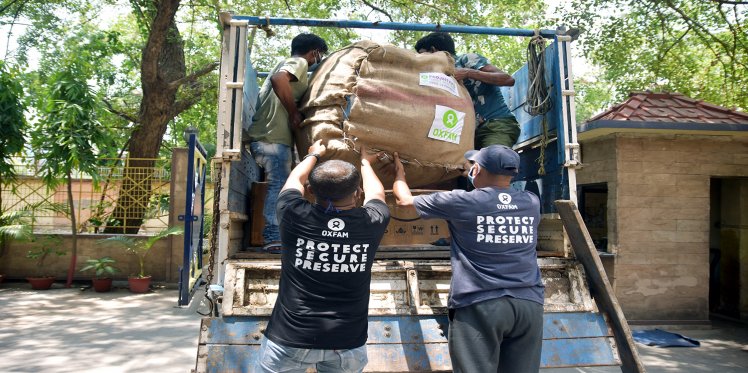
Millions Facing Double Disaster as Second Covid Wave Overwhelm Rural India
June 1, 2021 l New Delhi: The second wave has left public healthcare in shambles. People have lost their lives due to lack of proper medical facilities and infrastructure. The situation is getting a little under control in the cities, but it is still very grim in rural India where there are issues related to access to medical facilities, hospitals, doctors, technically trained staff or testing facilities.
Around 65% Indians out of the total population of approximately 1.3 billion live in rural India which hardly has rural health infrastructure. As per the Rural Health Statistics 2019, there is a shortfall of 43,736 Sub Centres (23 percent), 8764 Primary Health Centres/PHC (28 percent) and 2865 Community Health Centres/CHC (37 percent) across the country.
Oxfam India CEO Amitabh Behar said: “There was a time when we woke up every day to news of death of a friend, family, acquaintance. Villages were worse off - with no access to health care, no testing; in some cases, 20-25 people from a village died within a few days. No one in India has remained untouched by this pandemic. And most of these lives could have been saved if there was proper, adequate, and affordable healthcare for all."
People outside the major cities do not have the same access to social media to reach out for help or raise awareness of what is happening. Lack of testing, healthcare facilities and postmortems mean large number of cases in rural communities are not being recorded.
Apart from a healthcare calamity, India was already reeling under economic stress. The sporadic lockdowns and containment zones mean that once again it is the informal sector workers who are going to be worst hit. Latest report from the Centre for Monitoring Indian Economy (CMIE) states that over 1 crore Indians lot their jobs in the second Covid wave and around 97% household incomes have fallen since the start of the pandemic last year.
Millions who slipped into poverty last year due to job losses are now facing another looming crisis: hunger. India already has the largest population facing food shortage in the world, with an estimated 189 million people in India already undernourished before the pandemic began
While healthcare is the primary focus at this point in time, Oxfam India is also reaching out to some of the most marginalised and vulnerable communities with food. In the long run we will work towards providing livelihood support to informal sector workers and their families.
Oxfam India CEO Amitabh Behar said: “We are reaching out to public healthcare institutions, district administrations and COVID Care Centres with medical equipment such as oxygen concentrators, patient monitoring systems, oximeters, oxygen nasal masks, and thermometers along with PPE kits and safety kits for frontline health workers. We will also reach the most marginalised and vulnerable communities with food, ration, and safety kits.”
Through Mission Sanjeevani, our COVID-19 response in the second wave, we have provided 96 Oxygen Concentrators, 155 Oxygen Cylinders (40 Lts), over 1200 Oxygen Nasal Masks, 12 BiPAP machines, over 5000 diagnostic tools/equipment of various types, 1630 PPE kits, 90 ICU beds, community safety kits and one month’s dry ration supply to 15,500 people so far.
In addition to this, Oxfam India plans to strengthen the rural health ecosystem, in some of the most marginalised and vulnerable communities, by providing the necessary tools, training and inexpensive equipment needed by frontline health workers like Accredited Social Health Activists (ASHAs) for early identification of cases and timely referral to health centres, and hiring doctors, staff nurses and paramedics, wherever possible.
In the first month of our response to the second wave, we have provided support in Maharashtra, Delhi, Chhattisgarh, Karnataka, West Bengal, Tamil Nadu, and Uttar Pradesh. While continuing to work in these states among the most marginalised and vulnerable communities, Oxfam India will also look at expanding to Bihar, Odisha, Assam, Telangana, Andhra Pradesh, Kerala, and Gujarat.
Notes to the Editors:
- In the second wave, Oxfam India is working with the government and local administrations to deploy 7 Oxygen generation plants, 25 ventilators, 500 Oxygen concentrators, 3000 Oxygen cylinders (40 lts capacity), 11800 Oxygen nasal masks, 300 BiPAP machines, 1200 ICU beds, around 16000 diagnostic equipment of different types, and 19000 PPE kits. We are also aiming to provide a one-month dry ration supply and community safety kits to 225,000 people.
- Oxfam India also plans to train 35000 ASHA workers and provide them with medical kits for larger community outreach to ensure Covid appropriate behaviour and also tackle the issue of vaccine hesitancy.
- Since March 2020, Oxfam India has been working in 16 states, reaching the most marginalised and vulnerable with medical supplies, food kits, cooked meals, safety and PPE kits, cash, and livelihood trainings.
About Oxfam India
Oxfam India is a movement of people working to end discrimination and create a free and just society. We work to ensure that Adivasis, Dalits, Muslims, and women and girls have safe violence-free lives with freedom to speak their mind, equal opportunities to realize their rights, and a discrimination-free future.
📢Oxfam India is now on Telegram. Click here to join our Telegram channel and stay tuned to the latest updates and insights on social and development issues.
Recent News
Related Stories
03 Mar, 2022
Lohardaga, Jharkhand
A School Away From School
Not only are Mohalla Classes helping bridge the learning gap, the child-friendly and activity-based classes are proving to be the best way to ensure children do not drop out of schools and go back to formal schools once they reopen and run. The Lohardaga Mohalla Classes are helping children from the most marginalised communities catch up.
Read More
02 Mar, 2022
Pratapgarh, Uttar Pradesh
Shivani Rajak: The Volunteer and The Student
From a dalit family, and eldest of four siblings, Shivani is driven by two things—one, the strong belief that children have to study so that they have a better future and two, that she wants to be a teacher and is seeing this as her training to become one. She along with Alka, Oxfam India's community mobiliser, takes classes for 31 children—18 girls and 13 boys—in Gaukhedi village in Pratapgarh district.
Read More
28 Feb, 2022
Lakhimpur Kheri, Uttar Pradesh
Organic Farming Brings Life Back On Track
Before Oxfam India and Aim Trust started working in the Lakhimpur Kheri district, Rajeshwari and her husband would only use pesticides and chemical fertilisers in their field. They believed that the usage of chemicals on land was their only option and they were not aware of the harmful effects of dangerous chemicals on soil.
In 2018, Aim Trust organised a meeting in Jangalipurwa, in which Rajeshwari participated alongside 10 women. They learned about organic farming techniques that did not damage soil quality.
Read More
28 Feb, 2022
Koraput, Odisha
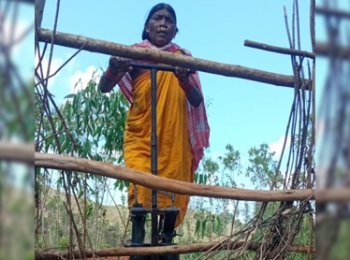
Treadle Pump: A Low Cost Game Changer
In May 2021, the group comprising 52 women farmers was formed in Lingamguda, Koraput. Sunduri Nayak was one among them. One of the first things they discussed was the farm pond, the difficulty in irrigation, and the need for proper irrigation in the area. Our team then started discussions around low cost irrigation technologies. After some deliberation, the treadle pump was decided as the idle irrigation system for the area.
Read More
