


Urgent G20 Action to Tackle Vaccine Inequality Required: Oxfam
- By Oxfam India
- 28 Oct, 2021


Oxfam calls for urgent G20 action to tackle vaccine inequality, hunger, climate change, and promote a fair economic recovery
28 Oct 2021 | Ahead of the G20 Summit in Rome, Italy, Oxfam calls on G20 leaders to take urgent action to dramatically scale up manufacturing and access to COVID-19 vaccines around the world, promote a fair economic recovery, fight hunger, lower dangerous greenhouse gas emissions, and help the poorest countries adapt to the climate change already happening.
Leaders at this G20 Summit in Rome, Italy, must tackle the unforgivable scandal of vaccine inequality and systemic mismanagement of the coronavirus pandemic, which has sparked an unprecedented wealth grab.
Rich countries originally promised that any successful vaccine would be “a global public good” and pledged 1.8 billion doses to developing countries. A year later, they have delivered just 261 million (14%). While their own vaccination rates are high, at 63%, just 1.8% of people living in poorer parts of the world have been fully vaccinated.
“Meeting in Rome at such a time of public health and economic turmoil, amid a worsening climate crisis, G20 leaders have a choice – either take urgent action against COVID-19, hunger, and climate change, or continue doing what they have been doing, talking some of the talk but walking none of the walk,” said Oxfam’s Senior Advisor, Jörn Kalinski.
Rather than supporting common-sense proposals by India and South Africa for trading nations to waive the intellectual property rights and patents on vaccine technology, in order to increase production and lower vaccine costs for all, rich countries have instead hoarded more vaccine doses than they need and supported the big pharmaceutical companies to retain all of the vaccine science and know-how.
“None of us are safe from the coronavirus until all of us are safe, but rich countries and pharmaceutical corporations have instead created a vaccine apartheid,” said Kalinski. “In Rome, G20 leaders must put aside their differences and starting the process to share the rights and the technology to vaccines, and scaling-up manufacturing around the world to ensure everyone has access to them.”
G20 leaders must also pursue a more equitable economic recovery and help to fight the scourge of growing hunger, around the world. More than 40 million people experience extreme levels of hunger primarily due to economic shocks largely caused by the pandemic. Mass unemployment and severely disrupted food production have led to a 40% surge in global food prices – the highest rise in over a decade.
“The pandemic has both highlighted and exacerbated our broken and unequal economic system,” said Kalinski. “Billionaire wealth has jumped from $8 trillion to $15 trillion in just two years while hundreds of millions of people now face crisis-levels of hunger and poverty. Together, the G20 can make a dramatic difference, by showing political will, and using its multilateral leadership to create the better future.”
The outbreak of the COVID-19 pandemic has posed unprecedented challenges for governments all over the world. The discrepancy in financing abilities between countries is striking: throughout 2020 advanced economies spent about 20% of their combined GDP to support their people, whereas the emerging markets’ and low income countries’ support stood at only 5% and 2% respectively. This requires an urgent G20 action to address, equitably and effectively, the constraints caused by high levels of indebtedness and shortage in domestic resources in the most vulnerable contexts of the globe.
Oxfam is also calling for G20 action to tackle the climate crisis, which is exposing the unequal and devastating effects of extreme weather events, rising temperatures, and sea level rises on the most vulnerable communities around the world. The poorest people, with fewest resources, and who have done the least to cause the problem, are being hardest hit.
“We still have time to reverse course and prevent the worst impacts of climate change,” said Kalinski. “G20 leaders must use this summit to signal their collective commitment to tackle climate change before the COP26 negotiations start in Glasgow next week.”
Oxfam calls on G20 leaders meeting in Rome to:
- Lift patents and share COVID-19 vaccine know-how and technology, invest in decentralized vaccine manufacturing hubs in developing countries, and redistribute existing vaccines equitably.
- Boost their climate actions by submitting ambitious NDCs based on their fair share ahead of COP26 and increasing their pledge of climate finance.
- Ensure a generous reallocation of Special Drawing Rights (SDRs) from richer countries to the developing ones that has to be interest- and conditionality-free and additional to existing ODA and climate finance commitments.
- Keep working on the package of tax reforms that have just been agreed to recover fairness and address more effectively and in a truly inclusive way corporate profit shifting and damaging effects of tax competition.
- Support and invest in universal social protection systems that can be flexibly scaled to address health, climate and economic shocks such as the pandemic and its consequences like the hunger crisis.
“G20 leaders must choose between a brighter, healthier, and more sustainable future for all or extreme wealth for just a few,” said Kalinski. “This is the time for G20 leaders to be bold. They can help win against the pandemic and create a just and equitable world for all of us to thrive, not just survive.”
About Oxfam India
Oxfam India is a movement of people working to end discrimination and create a free and just society. We work to ensure that Adivasis, Dalits, Muslims, and women and girls have safe violence-free lives with freedom to speak their mind, equal opportunities to realize their rights, and a discrimination-free future.
📢Oxfam India is now on Telegram. Click here to join our Telegram channel and stay tuned to the latest updates and insights on social and development issues.
Recent News
Related Stories
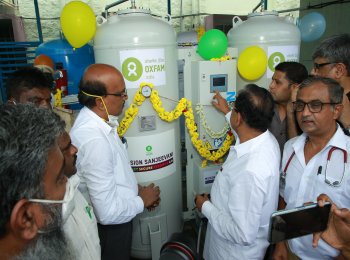
15 Aug, 2021
Tumkur, Karnataka
Oxfam India’s First Oxygen Plant in Tumkur
The 300 LPM Oxygen plant, set up under Oxfam India’s COVID-19 response ‘Mission Sanjeevani’, at the 80-bed government hospital at Koratagere in Tumkur in Karnataka will cater to people from 46 surrounding villages. Tumkur MLA, Dalit Leader and former deputy chief minister of Karnataka, G Parameshwara inaugurated the Oxygen plant on 26 July 2021.
Read More
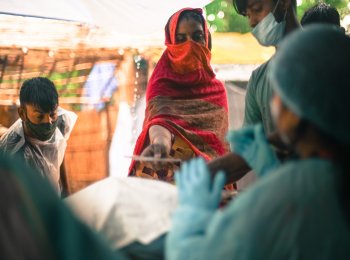
02 Aug, 2021
New Delhi
Delivering Hope and Dignity to Refugees
Oxfam India has been supporting communities worst affected by the pandemic, across India, for over a year now. At the heart of our response are communities already living on the margins such as daily wage workers, transgender communities, informal sector workers and differently abled people. We partnered with HAI to extend our support to refugees from Pakistan living in Delhi.
Read More
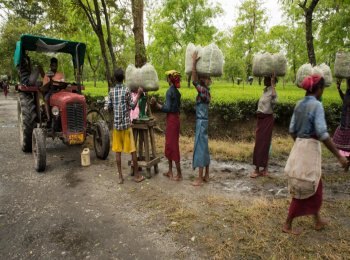
07 Jul, 2021
Assam
Labour Codes Training for Assam Tea Garden Workers
The Labour Codes will have significant impacts on the informal sector workers including the tea garden workers. A need was thus felt to train the workers around these Codes. The existing Plantation Labor Act, 1951 which used to govern the tea industry will be subsumed under these Codes. Different aspects of the Act will now feature in these four codes. In the above context, Oxfam India in collaboration with Centre for Workers’ Management initiated a training programme for workers across seven districts of Assam, during the month of June.
Read More
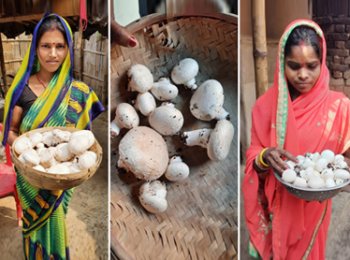
13 Apr, 2021
Sitamarhi, Bihar
Mushroom Cultivation Makes Communities Resilience
Oxfam India has been working with these communities through its disaster risk reduction programme since 2012. It was in 2017 that it finally started its livelihood intervention programme — mushroom cultivation and vermicomposting — with the women from the Musahar community. This proved useful during the lockdown in 2020.
Read More
