


Covid-19 Global Press Release
- By Oxfam
- 30 Mar, 2020
Health spending in poor countries must double immediately to prevent millions of deaths - Oxfam
Oxfam today called for a package of nearly $160 billion in immediate debt cancellation and aid to fund a Global Public Health Plan and Emergency Response, to help prevent millions of deaths as a result of the Coronavirus. The five-point plan would enable poor countries to take action to prevent the spread of the disease and build the capacity of health systems to care for those affected.
The pandemic has caused widespread suffering in rich countries, overwhelming some of the best healthcare systems in the world. But with the disease now spreading to many poor countries where high levels of poverty and inequality risk accelerating the disease, the public health challenges are even greater. Nearly 3 billion people across the developing world do not have access to clean water, millions more do not have access to adequate healthcare and live in crowded slums or refugee camps where social isolation is impossible. As women make up 70 per cent of health workers and carry out most unpaid care work, it will hit them the hardest.
Jose Maria Vera, Oxfam International Interim Executive Director said “In Mali there are three ventilators per million people. In Zambia, one doctor for 10,000 people. We know from Oxfam’s experience of fighting Ebola that with rapid action, this disease can be stalled and its catastrophic impact stopped. But we must act now and, on a scale, never seen before.
“Without urgent, ambitious and historic action, we could easily see the biggest humanitarian crisis since World War Two.”
The Imperial College estimates that in the absence of interventions the Coronavirus could have led to 40 million deaths in the coming year. Oxfam calculates that doubling the health spending of the 85 poorest countries, home to nearly half the world’s population, would cost $159.5 billion dollars. This is less than 10 per cent of the US fiscal stimulus to fight Coronavirus. While some donor institutions have begun to increase funding, the scale is not anywhere near the immense size of the challenge.
Oxfam is working with local partners, ministries of heath and key UN agencies in 65 countries to respond to the crisis and help save lives. In Cox’s Bazaar, Bangladesh where over 855,000 Rohingya are living in makeshift camps, Oxfam is already scaling up preventive measures like soap distribution and handwashing stations at communal facilities to help 70,000 refugees. In Zaatari camp, Jordan - the largest Syrian refugee camp in the world - Oxfam has already started hygiene and hand washing awareness for 2,000 children and aims to reach 78,000 people with water, hygiene and sanitation. And in Burkina Faso, where 780,000 people are internally displaced (IDP), Oxfam is currently working in some of the largest IDP areas ensuring that both host communities and displaced people have access to safe, clean water. To meet the desperate humanitarian, need now emerging, all governments must step up and fully fund the UN Global Humanitarian Response plan.
Oxfam is calling for the G20 and other national governments to tackle the virus head on by agreeing an ambitious Global Public Health Plan and Emergency Response. The five-point plan calls for:
- Huge investment in prevention. Public health promotion, community engagement, access for humanitarian workers and provision of clean water and sanitation, especially handwashing
- 10 million new paid and protected health workers. Together with urgent funding and equipment for local responders and humanitarians already on the ground
- Healthcare must be free. All fees for health should be removed, and free testing and treatment delivered
- Governments must requisition all private facilities. Governments must requisition all healthcare capacity in their countries, ensuring that all facilities, private and public are directed towards fighting this virus and meeting all other essential healthcare needs
- Vaccines and treatments must be a global public good. Global agreement must be reached that vaccines and treatments, when ready, will be made rapidly available to everyone who needs it free of charge. The profits of pharmaceutical corporations cannot be put ahead of the future of humanity
Vera added “It’s understandable that national leaders are focused on helping their own citizens, but G20 leaders must also find the space for supporting poor nations too. We can only beat this pandemic if we act in solidarity with every country and for every person. No one is safe until we are all safe.”
For more information and interviews, please contact:
Anna Ratcliff – + 44 7796 993 288 / anna.ratcliff@oxfam.org (UK)
Lisa Rutherford - + 44 7917 791 836 / lrutherford@oxfam.org.uk (UK)
Nesrine Aly - + 447503989838 / nesrine.aly@oxfam.org (Nairobi)
Recent News
Related Stories
20 Jan, 2022
Kerala
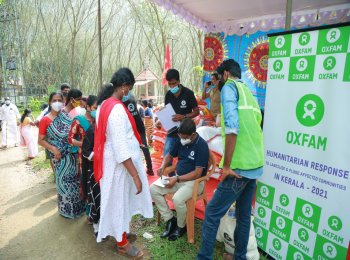
Supporting the Flood-Affected in Kerala
Jobin, Pankajakshi, Remya and Parvathy, though from different districts in Kerala suffered a similar fate in the October 2021 floods and landslides. They were all left without a source of income or food to feed their families. Oxfam India delivered dry ration and safety kits to 2771 families in Idukki, Alappuzha, Pathanamthitta and Kottayam.
Read More
16 Jan, 2022
Uttar Pradesh
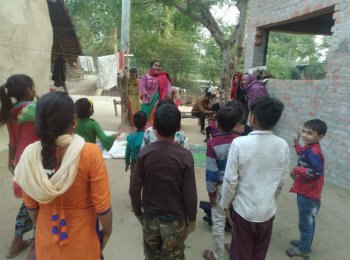
Mohalla Classes 2.0
Due to prolonged school closure, children had lost interest in attending classes and there was a wide learning gap during this period. To bridge the learning gap among children, Oxfam India has once again started 15 Mohalla classes covering four districts of Uttar Pradesh. In these classes 321 children including 155 girls and 166 boys are getting education with the help of volunteers and Oxfam India team. Out of these children, 77 children are out of school.
Read More
13 Jan, 2022
Dhubri, Assam
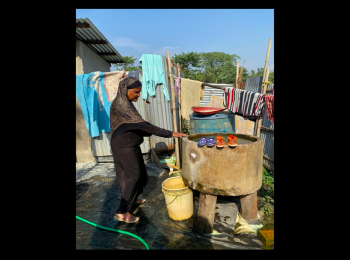
Handcrafting a Water Filter
Rowsonara, troubled with the heavy iron content in the water, first made a multi-layer mud filter with coal, sand and rocks through which contaminated water would trickle down to a chamber that would hold clean water. She bettered it by making a cement filter. Quite a few people in the area also replicated the filter in their respective households and now have access to water that is better fit for consumption.
Read More
07 Jan, 2022
Karnataka
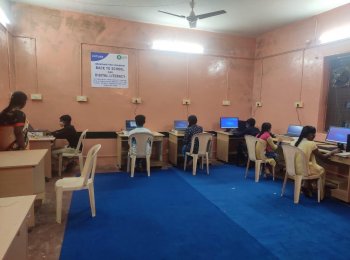
Back to School and Digital Literacy
Schools which were on our Bangalore trail now have refurbished computer rooms as part of the Oxfam India-Virtusa 'Back to School and Digital Literacy' programme. 537 children belonging to some of the most marginalised communities will now have access to computers. And of course, a whole lot of stationery and sports item as well!
Read More
