


Consultation on Trans-Boundary Cooperation for Effective Management of Water Risks, Bhutan - India
- By Oxfam India
- 08 Jul, 2019
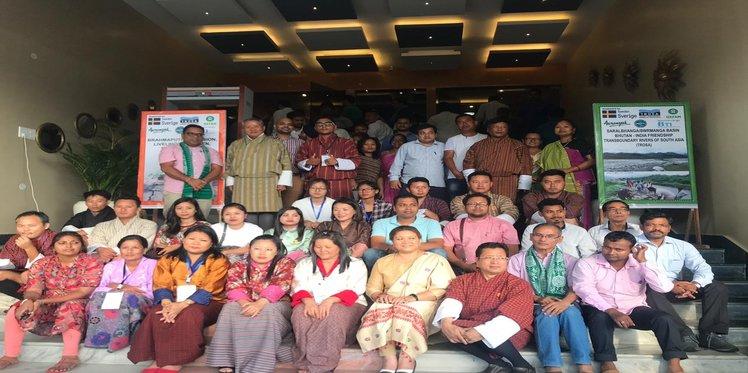
Kokrajhar (Assam), June 21st, 2019: As multiple countries in the South Asian region struggle individually to deal with the impacts of climate change induced disasters, unfortunately, there is yet to be promising development in collectively combating these vulnerabilities at the regional and transboundary level. Several rivers that flow down from Bhutan to India - with 56 such rivers flowing down from Bhutan to Assam itself. Though these rivers are the lifeline for riparian communities in both countries, they oftentimes wreak havoc, with flash floods, long term inundation, erosion, cyclones and siltation. Unscientific mining, unsustainable fishing, and improper water management and flood protection measures could be likely causes for cumulative risks and vulnerabilities in the region. If governed effectively, these rivers could help both countries thrive in trade and tourism, as well as enabling a prosperous livelihood for the respective riparian communities.
With Bhutan and India enjoying a friendly and cordial relationship, and in recent times, CSO to CSO ties strengthening, amicable ties between border communities and their collective approach in managing rivers is being cited as an early instance of transboundary cooperation. As understanding grows, transboundary communities are making continued endeavors to bring respective cultures together through various activities.
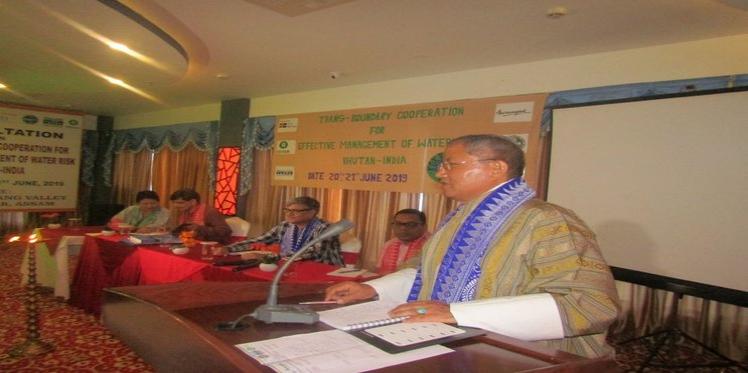
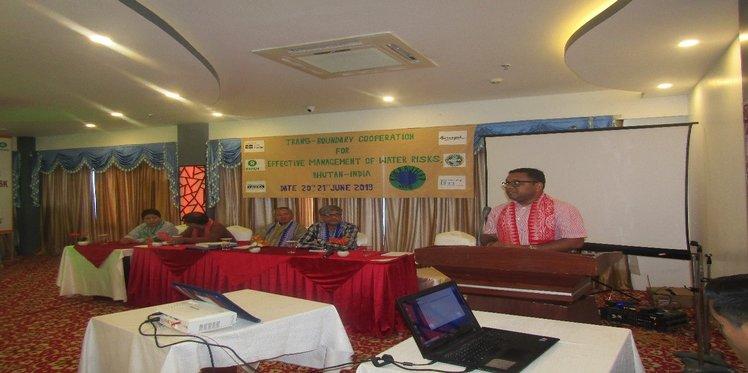
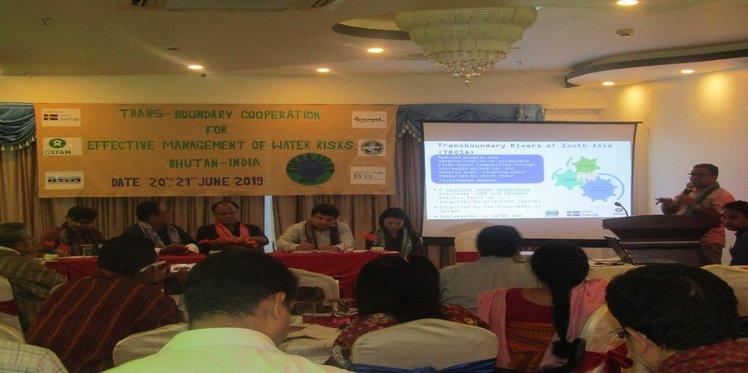
In this context, a two-day consultation was organized, involving representatives from Government, CSO, Media and Academic Institutions. Titled ‘Consultation on Trans-Boundary Cooperation for Effective Management of Water Risks’, it was held on June 20th and 21st, 2019, at Kokrajhar, BTC, Assam.
Tireless efforts by women leaders from India and Bhutan have resulted in early platforms to enhance women’s participation in trans-boundary risk governance. A cadre of community based women leaders are coming together to collectively manage risks in the last mile with support from upstream and downstream communities.
The Consultation on Trans-Boundary Cooperation for Effective Management of Water Risks was a collective effort of these women champions, represented by several agencies, including North East Research & Social Work Networking (NERSWN), Aranyak and Bhutan Transparency Initiative (BTI), Bhutan India Friendship Association, supported by Oxfam’s Project TROSA.
This two-day consultation aimed at strengthening transboundary collaboration and cooperation with Government, CSOs, Academia and others with the following long term objectives:
- Transboundary communities are enabled to reduce vulnerability to water resource related shock, together, including from water stress and disasters.
- Transboundary Governance is improved as a result of relevant bilateral mechanisms and protocols for transboundary risk governance in India and Bhutan
- CSOs and Networks increasingly participate in and influence transboundary risk governance
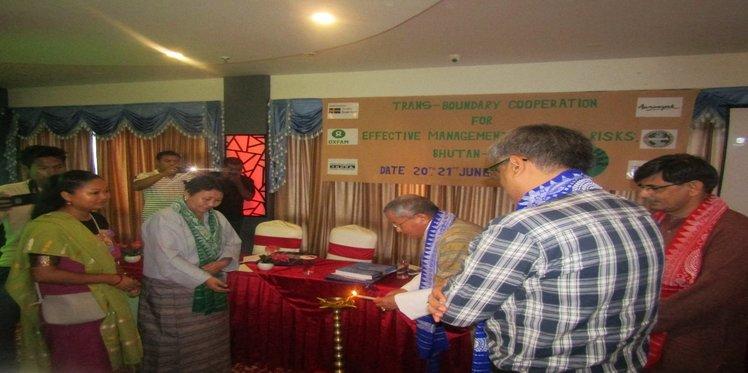
The Consultation was jointly inaugurated by Biren Chandran Phukan, IAS, Principal Secretary, BTC, and Dr. Kinzang Dorji.
Chairperson, BTI Board (Former Minister, Prime Minister & Speaker) and Mr. Pankaj Anand (Director, Oxfam India) in the august presence of eminent representatives from Bhutan and India.
In his inaugural address, Dr. Kinzang Dorji emphasized, “Bhutan and India have always been friendly nations and share a time tested relationship. This consultation is a step towards strengthening this relationship, specially through managing water risks.”
Pankaj Anand further highlighted through his keynote address, “Effective management of water risks will not only lead to joyous access to water, but will help transform the conflicts around water into a peaceful state. I am sure this is just the beginning; both countries together have to realize different goals which will benefit either side.”
Dr. Sunil Kaul (Managing Trustee, the ant) asserted, “Boundaries should become a failure gradually. We should be reminded constantly that boundaries divide. Water sees no boundary.”
Drawing focus to the roles of CSOs in transboundary cooperation and youth leadership in water cooperation, Mr. Jyotiraj Patra (Manager - TROSA, Oxfam Cambodia) said, “We must utilize this energy of the youth to take forward the agenda of water cooperation. How can we make these actions more sustainable? How can we bring stronger partnership mechanisms and deliver at the regional level?”
Ms. Pema Lhamo (Founder & Executive Director – BTI Secretariat) discussed at length that cooperation is imperative for peace, safe environment and prosperity of border communities.
Dr. Kinzang Dorji steered the technical session on Trans-Boundary Cooperation for Managing Water Risks, and explained, "Water can be an instrument in deepening a long-standing friendship between India and Bhutan."
Through the day, eminent participants discussed and deliberated on different topics, resolutions of these discussions will be declared at the end of the consultation.
The second day commenced with a session on Women Leadership for Effective Bhutan-India Cooperation, followed by an open brainstorming session on Re-Imagining Bhutan-India Friendship.
Establishing that partnership and collaboration of civil societies will advance the benefits of bilateral cooperation beyond diplomatic relations and will yield wider benefits to the grassroots communities, the two-day Consultation also dwelt on the further scope for multiple formal platforms for collective action, and concluded with a formal signing of the Kokrajhar Call for Action on Bhutan – India CSO’s Partnership for Inclusive Water Governance.
Oxfam India released this press statement on 21 June 2019.
For media queries please contact Himanshi Matta, 91-8860182310.
Recent News
‘Bois Locker Room Talk’ is not normal or acceptable
14 May, 2020
Guest workers are hosts in this kitchen
01 Apr, 2020
Covid-19 India Press Release
30 Mar, 2020
Related Stories
23 Nov, 2022
Nalanda, Bihar
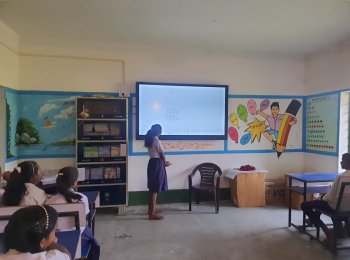
Making Schools Fit And Smart
Oxfam India-HDFC Bank’s Holistic Rural Development Programme (HRDP) is working in 15 village of three blocks of Nalanda district. One part of the project works on improving schools; as part of the project it has renovated schools and developed smart class installing smart boards and computer labs in 10 schools.
Read More
14 Nov, 2022
Nalanda, Bihar
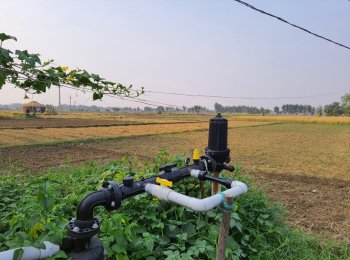
Convergence With Govt Schemes Improves Productivity
For the communities development to be sustainable and with a deeper lasting impact, it is also essential to facilitate linkages with government schemes. One such initiative was the instalment of drip irrigation systems in 10 villages in the Hilsa block. Drip irrigation helps ensure optimum crop growth. In 2022, Oxfam India chose 10 farmers—with land and keen to experiment with drip irrigation—and installed 0.4 hectare drip irrigation systems in their fields so they could be eventually be linked to the Pradhan Mantri Krishi Sinchai Yojana Scheme.
Read More
10 Oct, 2022
Nalanda, Bihar
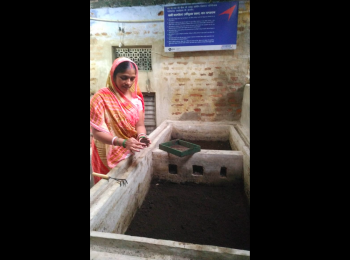
Vermicompost Brings Better Yield And Better Income
In March 2021, Babita Devi constructed the vermicompost pit. She first started using it in her own field and later started selling it to fellow farmers in the village. She received the vermicomposting training throughout Project Utthan, an Oxfam India-HDFC Bank initiative.
Read More
06 Oct, 2022
Sitamarhi, Bihar
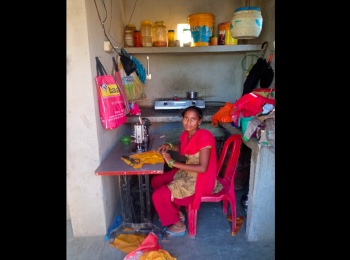
Cash Push To Revive Tailoring Business
Indu Devi was provided with INR 15000. She used the money to re-launch her tailoring business. She purchased a new sewing machine along with raw materials. She named her shop “Divanshi Tailors”. All this has led to mass promotion. Customers from her village as well as from nearby villages started reaching out to Indu Devi.
Read More
