


Ancestral Property: SC Judgement Welcome, Time to Address Regressive Norms as a Society
- By Oxfam India
- 12 Aug, 2020

Oxfam India welcomes the Supreme Court judgement of 11 August 2020 which has chipped away one more barrier women faced to equal rights in ancestral property. The judgement is significant as it gives daughters right to their ancestral property irrespective of whether the father was alive in 2005. The year 2005 is important because the amendment to the Hindu Succession Act, 1956 making daughters ‘coparceners’, i.e., equal rights holders as sons in an undivided joint family property, was passed in the year 2005. This itself was a landmark amendment for women’s equal right to property. However, a Supreme Court judgement of 2015 restricted this right, and where fathers had died before 2005, daughters could not equally inherit ancestral property. The judgement has done away with this restriction.
Oxfam India’s work in the community shows that both social and legal barriers contribute to women not being able to access property rights.
"Laws are but a product of patriarchal society and hence breaching this fortress is especially important. This judgement does exactly that. However social norms such as the ritual of ‘Haq Tyaag’ widely practiced in Rajasthan mark the reluctance in society to accept women’s equal right to property," Ranu Bhogal, Policy Research and Campaigns Director at Oxfam India said.
'Haq Tyaag' is the celebration of a married daughter giving up her property for her brother! Such rituals abound in North India, and in most parts of India women never exercise their right to property lest they lose their ‘maika’ or natal home.
One in three women in India face some form of violence, the largest proportion being of domestic violence. Often, natal homes are the only recourse women have in such circumstances. By traditional social norms, neither the marital nor natal home belongs to the woman—one reason why women have had to put up with abusive relationships.
"As we celebrate this judgement, we must recognise that as a society we still need to traverse some more distance. Social norms continue to override the possibilities provided by law. To make this law socially acceptable a lot more work will be needed. For example, property rights are crucial for single, unmarried women, which is often neglected. Often women are expected to marry as a form of social security. The practice of kanyadaan and dowry needs to be done away with. That will truly enable the implementation of this right. Till we achieve that, women will continue to be dissuaded from demanding their right and the male heirs will justify denying these rights. The courts have done their job. The rest of the work has to be done at the societal level," Ranu Bhogal said.
Legal changes, such as this judgement, have a big role to play also in changing these regressive social norms. We need to create an enabling environment for women and girls to exercise their rights!
Oxfam India works in five states — Bihar, Jharkhand, Uttar Pradesh, Chhattisgarh and Odisha — to help young people challenge social norms and reduce acceptance of gender inequality/gender-based discrimination.
For more information, please contact:
- Savvy Soumya Misra (Media): savvy@oxfamindia.org
- Amita Pitre (Gender Justice Lead): amita@oxfamindia.org
Note to the Editors: Oxfam India’s spokespersons are available for interviews. To arrange interviews or further queries please contact Savvy Soumya Misra: savvy@oxfamindia.org
Recent News
Inequality Kills: India Supplement 2022
17 Jan, 2022
FCRA RENEWAL DENIED
02 Jan, 2022
Inter-State Women Leaders Convention
17 Dec, 2021
#SorryThankYouTataByeBye to Patriarchy
29 Nov, 2021
Patients Rights and Inequality in Vaccine Survey
23 Nov, 2021
Chhattisgarh CM Launches Gender Curriculum
15 Nov, 2021
Related Stories

28 Jun, 2023
Kalahandi, Odisha
The All-Rounder Women Farmers of Talnuagaon
The women farmers of the Ma Saraswati SHG—who run the Farmer Field School in Talnuagaon in Manikera GP—sell saplings and vegetables, provide irrigation solutions to farmers who were otherwise restricted only to the Kharif season, and produce their own organic fertiliser. The FFS has been set up under Project Utthan—an Oxfam India-HDFC Bank’s HRDP initiative.
Read More
27 Apr, 2023
Koraput, Odisha
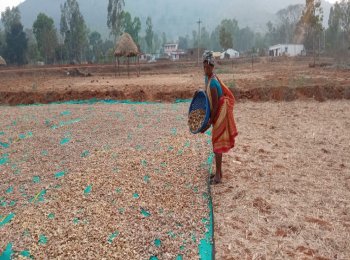
The Ginger Women of Koraput
A group of women farmers in the Pottangi and Semiliguda blocks of Odisha’s Koraput district are marketing ginger and doing a good job of it! Here small farmers rely on tuber crops for their income and sustainability. However, marketing these crops has been a major challenge. Oxfam India partnered with Prastutee to initiate livelihood initiatives with support from the Sita Devi Malhotra Charitable (SDMC) Trust to address these issues.
Read More
26 Apr, 2023
Sitamarhi, Bihar
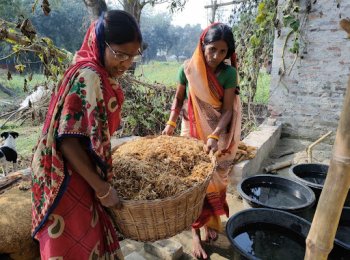
Spawning A Success Story In Parsauni Village
The Jeevan Jyoti Mushroom Utpadak Samuh consisting primarily of women from marginalised communities has made women entrepreneurs out of those women who once found it extremely difficult to make ends meet. Now they are nurturing business expansion plans, thanks to Oxfam India-HDFC Bank project Project Utthan.
Read More
17 Apr, 2023
Sitamarhi, Bihar
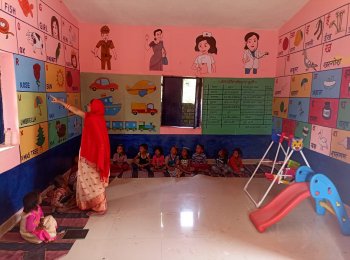
Anganwadi Centre No.115 Is Now A Model Centre
Project Utthan has had a significant impact on Anganwadi Centre No.115. Attendance has increased, and children now spend more time in the Centre; they are showing keen interest in learning with the new pictorial paintings and age-appropriate toys. Sushma is proud of her new renovated AWC. In fact, Sushma's presentations about the renovated AWC at various ICDS platforms have successfully drawn the attention of officials to the potential of replicating this model in other AWCs.
Read More
