


Oxfam India organises national consultation on 'Making India’s National Disaster Management Plan Inclusive'
- By ursila
- 30 Nov, 2018
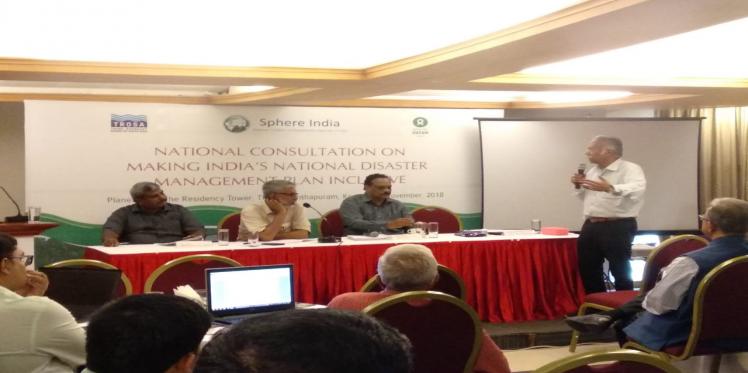
The National Disaster Management Authority has updated the National Disaster Management Plan (NDMP) and the draft updated NDMP, 2018 document has been kept in public domain for review and feedback with 25th November, 2018 as the submission deadline.
In this regard, a national consultation on ‘Making India’s National Disaster Management Plan Inclusive’ has been organized by Oxfam India in collaboration with Sphere India, Transboundary Rivers of South Asia (TROSA) and Inter Agency Group, Kerala at the Residency Tower, Thiruvananthapuram Kerala on 23rd November, 2018. The National Consultation was inaugurated by Mr. P.H Kurian IAS, Additional Chief Secretary, Revenue and Disaster Management, State Relief Commissioner and Convenor, Kerala State Disaster Management Authority in the presence of Dr. Anil Kumar Sinha, IAS (Retd), founder Vice-Chairman, Bihar State Disaster Management Authority, Government of Bihar; Prof. Vinod Menon, Founder Member, National Disaster Management Authority, Government of India; and 40 other participants from various non-government organizations working in the field of disaster management and experts in the field from the states of Assam, Bihar, Kerala, Odisha and Uttar Pradesh.
The objective of the National Consultation was to discuss the various chapters of the draft NDMP, 2018 and suggest modifications to make the draft NDMP, 2018 operationally robust and strategically comprehensive to address the concerns of social inclusion, transboundary disaster risk reduction, improved coordination, addressing regional/inter-state diversities, accountability to affected population and the role of civil society organizations. This is envisaged to make India’s Draft NDMP, 2018 incorporate the spirit of the three global framework; Sendai Framework for Disaster Risk Reduction (SFDRR, 2015-2030), Paris Agreement on Climate Change (COP 21) and Sustainable Development Goals (SDGs). Through this process, the Government of India’s draft NDMP 2018 is expected to get recognized as a good practice initiative which could inspire other governments in the South Asian Region and also within the country to improve resilience building of communities affected by natural disasters, climate change and extreme events.
In his welcome address, Mr. Andrio Naskar, India Humanitarian Program Manager, Oxfam India observed that the draft NDMP 2018 provides an opportunity to ensure that this plan is based on the contextual reality of the complex inter-relationship between poverty and inequality in disaster prone and disaster affected areas Mr. Vikrant Mahajan, CEO, Sphere India emphasized on the aspects of improved coordination for preparedness, response and recovery and argued for a better GO-NGO coordination mechanism within the responsibility framework defined in the draft NDMP 2018. Prof. Menon stated that Social Inclusion’ is one of the five core pillars of the draft NDMP2018 and reflected that the consultative process done in 11 districts and in 4 states (Assam, Bihar, Odisha and Uttar Pradesh) helped to compile the aspirations of civil society organizations assisting the strengthening of multi-hazard preparedness, disaster risk reduction, emergency response capacities, rehabilitation, reconstruction and recovery through an inclusive multi-stakeholder engagement. Mr. Anil Sinha highlighted the need to strengthen the institutional mechanisms at the national, state, district and sub-district levels for mainstreaming disaster risk reduction in development planning Mr. P.H Kurian shared the complex challenges in rehabilitation, reconstruction, and recovery in the recent devastating Kerala floods and landslides. He argued for improving the disaster management processes especially by restoring disrupted livelihoods and repairing damaged infrastructure and public assets. He felt that the Government of India must review the memorandums submitted by the disaster affected state governments in a time bound manner and cater to the needs of the disaster affected communities in a prompt and efficient manner.
The consultation involved various structured methods of group discussion and open sharing and the participants discussed the various components of the draft NDMP 2018 and suggested several practical recommendations. The findings and recommendations from these consultations will be shared with the National Disaster Management Authority.
Recent News
Related Stories
15 Aug, 2021
Tumkur, Karnataka
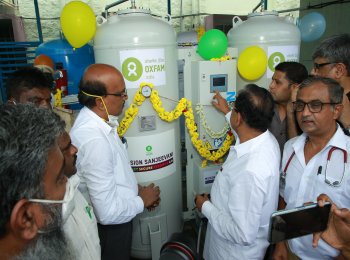
Oxfam India’s First Oxygen Plant in Tumkur
The 300 LPM Oxygen plant, set up under Oxfam India’s COVID-19 response ‘Mission Sanjeevani’, at the 80-bed government hospital at Koratagere in Tumkur in Karnataka will cater to people from 46 surrounding villages. Tumkur MLA, Dalit Leader and former deputy chief minister of Karnataka, G Parameshwara inaugurated the Oxygen plant on 26 July 2021.
Read More
02 Aug, 2021
New Delhi
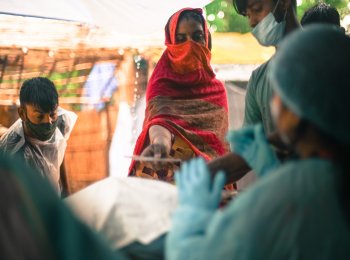
Delivering Hope and Dignity to Refugees
Oxfam India has been supporting communities worst affected by the pandemic, across India, for over a year now. At the heart of our response are communities already living on the margins such as daily wage workers, transgender communities, informal sector workers and differently abled people. We partnered with HAI to extend our support to refugees from Pakistan living in Delhi.
Read More
07 Jul, 2021
Assam
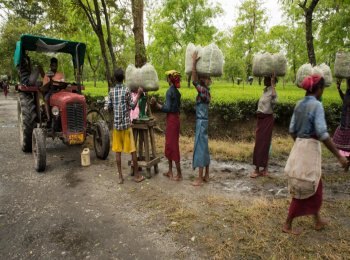
Labour Codes Training for Assam Tea Garden Workers
The Labour Codes will have significant impacts on the informal sector workers including the tea garden workers. A need was thus felt to train the workers around these Codes. The existing Plantation Labor Act, 1951 which used to govern the tea industry will be subsumed under these Codes. Different aspects of the Act will now feature in these four codes. In the above context, Oxfam India in collaboration with Centre for Workers’ Management initiated a training programme for workers across seven districts of Assam, during the month of June.
Read More
13 Apr, 2021
Sitamarhi, Bihar
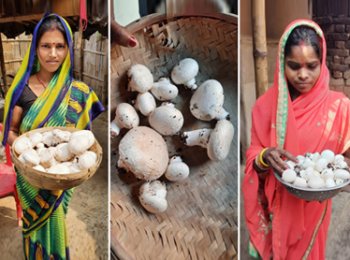
Mushroom Cultivation Makes Communities Resilience
Oxfam India has been working with these communities through its disaster risk reduction programme since 2012. It was in 2017 that it finally started its livelihood intervention programme — mushroom cultivation and vermicomposting — with the women from the Musahar community. This proved useful during the lockdown in 2020.
Read More
