


'We may die but we won't leave': Indian forest dwellers' fury as 11 million face eviction
- By The Telegraph
- 16 Jul, 2019

Sheltered from the world by towering palm trees lies the rudimentary but charming home of Dewansh Kalundia, 30.
Dewansh, who lives with his wife Raimuni, 29, and three children, is one of 350 residents of the remote village of Boula, which is deep in the Similipal Sanctuary forest – tiger territory – in the tropical east Indian state of Odisha.
Like the rest of Boula’s inhabitants Dewansh supports his family by cultivating rice and vegetables and tending to a small herd of goats and a chicken coop.
A warm breeze blows across the clearing outside his home where his children happily play whilst relatives return from a hard day’s toil on their nearby paddy fields.
But this tranquil scene is at odds with the anger simmering inside Dewansh. Anger at a government which wants to strip him and his neighbours of their land and livelihoods.
“If [the government] takes my land, it will become impossible to support nine people from the one acre remaining,” he says, gesticulating at the patch that would remain.
“The land is the source of my life and my livelihood – we consume our crops and the rest we sell to pay for my children’s schooling and medicines.
“We do not want to migrate from this village because we don’t know life outside the forest. They can kill us but we will not leave our land," he says.
A group of his neighbours have gathered to hear his outburst and sound their support.
“We may die but we are not going to leave,” echoes Durga Singh Gadsara.
Dewansh and his neighbours are some of an estimated 11 million forest dwellers that are set to either partially or entirely lose their homes, land and livelihoods in July as a result of a highly controversial legal ruling.
In February, India’s Supreme Court ruled that indigenous and local households whose land claims had not been settled – roughly two million households or about 11 million people – would be evicted from their homes by July 24.
These people – often belonging to remote tribal groups – have for many generations carved out their existence in the country’s almost impenetrable forests. After India won independence from British rule in 1947 these forest dwellers technically no longer had legal ownership of the land that they lived on and large swathes were seized by both state governments and developers, with tribal communities repeatedly evicted.
In 2006 the Indian government introduced the Forest Rights Act in an attempt to resolve the long-running conflict over land ownership in its forests.
The act detailed that to stay on their land, forest-dwellers would have to apply for a permit from the state government. A separate permit was also needed for the inhabitants of villages like Boula to continue to use the forest around them for their livelihoods – known as community rights.
Eviction of forest-dwellers was supported by a number of Indian conservationist groups who accused them of damaging the environment.
While this is certainly true in a minority of cases, this accusation has stunned campaigners who say forest dwellers have actually protected their habitat.
About 1.9 million claims for land ownership have been rejected by the government which could lead to millions of people being evicted from their homes, according to Oxfam India.
The Union Ministry of Tribal Affairs also revealed that only a minority of applicants – less than two per cent – had been granted community rights.
Arun Agrawal, a professor in the Center for Political Studies at the University of Michigan and an expert in conservation, said the Supreme Court should reverse its decision.
He added: "Should it not do so, the effects on local and indigenous peoples will be truly horrific. In a single act of unthinking collusion, the Supreme Court and the Modi government will evict more people from their lands than the British colonial state and its forest administration did in the entire 200-year history of rule over the Indian subcontinent.”
The odds have been firmly stacked in the favour of state governments as forest-dwellers are often both poor and illiterate.
Many were unaware that the Forest Rights Act had been passed and the vast majority had no idea how to file a claim, let alone how to source legal assistance to fight the state government.
No compensation will be provided to those set to lose land and homes and activists have accused state governments of failing to support forest-dwellers who wish to appeal by withholding evidence of inter-generational residency. In addition they have not communicated updates so that deadlines are missed on a massive scale.
“This judgment is a death sentence for millions of tribal people in India, land theft on an epic scale and monumental injustice,” said Stephen Corry, director of Survival International.
“It will lead to wholesale misery, impoverishment, disease and death, an urgent humanitarian crisis and it will do nothing to save the forests which these tribes people have protected for generations.”
Dewansh Kalundia is typical of those facing eviction.
With the support of Oxfam India and other local NGOs, he filed his application for residency on the 10 acres of land he inherited from his father. However, the Odisha state government granted him just 1.63 acres – little more than his house and its surrounding land.
While he is permitted to stay in his home, he would no longer be able to earn a living on the meagre land he has been allocated.
He has never travelled outside the village other than to visit neighbouring settlements to trade crops and other goods and does not have the skills to seek regular employment elsewhere.
"If land and forest are taken away from them without their consent and without any compensation, they will be forced into distress migration," said Sreetama Gupta Bhaya, programme co-ordinator at Oxfam India.
"If they are forced to migrate, they will be pushed into abject poverty and a very poor quality of life.
"Globally, distress migration has shown to have adverse impact on towns and cities. There is bound to be a pressure on the demand for jobs, resources, such as food and water and services, such as education and health.
"Due to lower levels of education the immigrants will be forced to take up low-paying unskilled jobs without any access to proper services such as healthcare," she says.
Before leaving Boula, the Telegraph accompanies Dewansh on the village’s forest patrol.
Each day after school, teenagers head in to the forests to look for illegal loggers and poachers and to collect the leaf from the sal tree which is then fashioned into plates for sale.
The villagers are shocked that they have been labelled as destructive and are being evicted from the forest they have worked so hard to protect.
Sauna Henbram, 23, lives in the village of Batratola – about 18 miles from Boula – with his wife, Bale, 21 and his four month old daughter.
Unlike Dewansh, he has not been allocated any land at all by the state government and faces a total eviction in July, set to lose both his farmland and his home.
"It will be impossible for me to live my life when this happens, as I have no other small business," he says.
Despite having never left his village before he says that from the summer he will have to look for construction work and sleep rough in the cities of Odisha.
He is concerned that his lack of experience will place him at risk of exploitation and leave his family unprotected and in danger.
"If I have to go, who will look after my family? If we are evicted we will have no food anymore and I will not be able to afford to send my brothers to school.
"We don't want to go outside."
Original article here
Recent News
Related Stories
18 Mar, 2021
Mumbai
Sewing A Better Future
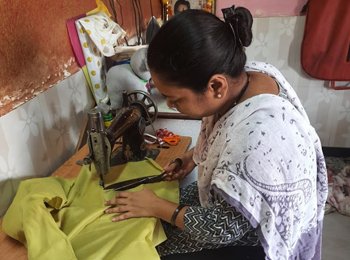
In Mumbai, livelihood trainings are being carried out among 12 SHGs in Govandi and Mankhurd. Despite the economy opening up, many have still not been able to either get their jobs back or restore the wages that they were getting pre-pandemic. The situation is worse for those who lost their sole breadwinners to the virus. Here's a story of 3 women who have been able to make ends meet, thanks to the livelihood training they received. These trainings are being done in collaboration with Siemens.
Read More
10 Mar, 2021
Mayurbhanj, Odisha
Youth Volunteer As Teachers During Pandemic
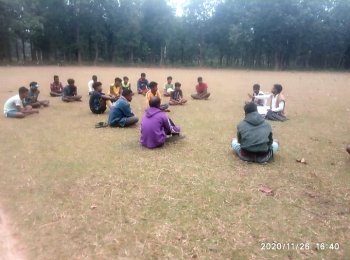
Last year, the sudden lockdown led to the closure of more than a million schools throughout the country leading to disruption in education of school students. While children everywhere faced the impact of this discontinuity of their education, the situation proved to be more severe for children from remote rural areas who had no access to internet, smartphone or electricity to be able to access virtual classes. This problem was further exacerbated for tribal students who further faced the challenge with regard to the language of instruction used for classes that were being broadcast. This situation prompted the Dharamveer Youth Group from Prasan Chandrapur Village of Noto Panchayat to come forward and take the responsibility of supporting children from the community so that they could continue their education.
Read More
14 Feb, 2021
Chhattisgarh & Jharkhand
Solar Boost For Rural Livelihood
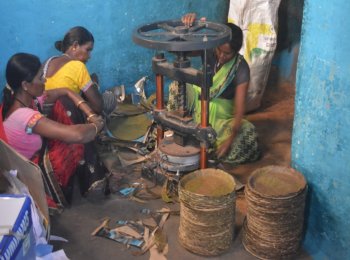
Based on the success of the solar-powered Sal leaf plate making unit in Chhattisgarh, two more machines were installed in Jharkhand and Chhattisgarh. This value addition will improve the quality of the product and fetch better price than the traditional hand-made plates. These have been set up in Bade Gobra village in Mainpur block in Chhattisgarh's Gariaband district and in Mohanpur Village in Sundarpahari Block in Jharkhand's Godda district.
Read More
11 Feb, 2021
Kushinagar, Uttar Pradesh
Making Toilets Sustainable
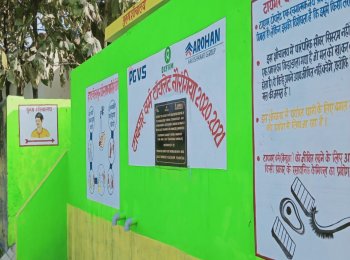
On February 2, 2021, Oxfam India handed over a Tiger Worm Toilet (TWT) complex to the Naurangiya panchayat in Uttar Pradesh’s Kushinagar district. Present at the handing over were community members and representatives from the Arohan Foundation and our on-ground partner PGVS. The toilet complex has five toilets and is built in the complex of the panchayat bhawan.
Read More
