


Oxfam plea to buy from labour-act followers
- By The Telegraph
- 14 Oct, 2019
Oxfam, a confederation of 20 organisations focusing on alleviation of global poverty, has asked tea brands to buy only from Assam producers who implement the Plantations Labour Act.
In its report on Addressing the Human Cost of Assam Tea — An Agenda for Change to Respect, Protect and Fulfil Human Rights on Assam Tea Plantations, which was released on Thursday, Oxfam said solutions lie in a fairer sharing of the end-consumer price of tea, stronger gender policies and a review of plantation labour laws to ensure that women and men in Assam can lead dignified lives.
It said new estimates, commissioned by Oxfam and undertaken by the Bureau for the Appraisal of Social Impacts for Citizen Information, show that supermarkets and tea brands in India retain more than half (58.2 per cent) of the final consumer price of black processed tea, with just 7.2 per cent for workers. It asked tea brands to favour suppliers who implement the act and incentivise and enable others to do so. Tea producers have been complaining that big buyers don’t pay enough.
The organisation said tea brands/supermarkets should work with suppliers, government and civil society to improve producers’ ability to provide decent housing, healthcare, water, sanitation and education through improved trading practices and external support. “This can be supported through paying higher prices for fresh tea leaves and excluding the costs of labour from price negotiations. It should ensure that tea is priced sustainably,” it said.
“It is difficult to trace most exported Assam tea to its origins. Many supermarkets fail to disclose the country or region of origin of their private label black tea. In India, supermarkets and tea brands also remain opaque about their supply chain relationships,” it said. It asked supermarkets and tea brands to publish the country and region of origin, supply chain information and distribution of end-consumer price on tea packaging.
Related media coverage
1. Tea workers get a raw deal as brands, marts grab lion's share
2. Assam tea workers get only 7 percent of price, says report
3. 'Assam tea estates violating labour laws'
4. Assam tea workers get only 7 percent of price, says report
5. Assam tea workers get only 7% of price: Oxfam
6. Oxfam report flags Assam tea for labour rights violation
7. Study finds poor wages, housing, healthcare in Assam TEs
8. Oxfam blames brands for inequality to Assam tea workers
9. Assam tea workers get only 7 percent of price, says report
10. BIZ-TEA
11. Of Rs. 68 for 200 gm branded Assam tea, workers get only Rs. 5: Study
12. Assam tea workers get only 7 percent of price, says report
13. Supermarkets squeezing tea workers share in Assam tea price
14. Of Rs. 68 for 200 gm branded Assam tea, workers get only Rs. 5: Study
15. Assam tea workers get only 7% of price says report
16. Oxfam calls consumers and supermarkets to support Assam tea sector workers' minimum wages hike
17. Assam tea workers get only 7% of price: Report
18. Assam tea workers get only 7 percent of price: Report
19. Assam tea: a glimpse of its forbidden history and incredible health benefits
20. Assam tea workers get only 7 percent of price, says report
Recent News
Related Stories
28 Jul, 2016
Chhattisgarh
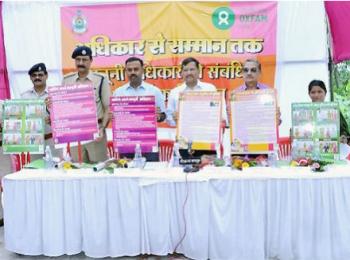
Oxfam India and Chhattisgarh Police jointly released awareness posters
In order to create awareness among people about rights of women and children regarding crime related issues Oxfam India in association with Chhattisgarh Police developed posters, in pictorial form and in easy language and unveiled in the state capital.
Read More
20 Jul, 2016
New Delhi
Women’s Right to Agricultural Land Removing Legal Barriers for Achieving Gender Equality
Women’s land rights (WLR) have been and continue to be a live agenda in social development discourse of India. The importance of WLR has been discussed in the context of agriculture; poverty reduction; reduction in gender based violence; women’s well-being and agency.
Read More
16 Jul, 2016
New Delhi
Why is passing the Women’s Reservation Bill urgent?
Women’s reservation in the national parliament and state legislatures was a necessary step to ensure women’s participation in decision-making. Assuming that women would automatically be able to create a level playing field in the political arena without any affirmative action is a misplaced idea.
Read More

15 Jul, 2016
New Delhi
BREXIT & What It Means for Humanitarian Aid
Brexit – the campaign for Britain’s exit from the EU - took centre stage in political and economic discussions the world over. On June 23, 2016, in a historic referendum, a majority of 51.89% voted to leave the EU. But what about international aid in India and the rest of the world?
Read More
