


Gareeb Kalyan Anna Yojana has been extended for five more months
- By Down To Earth
- 14 Jul, 2020
The Pradhan Mantri Gareeb Kalyan Anna Yojana (PMGKAY) has been extended for five more months, till November-end, on June 30, 2020.
Prime Minister Narendra Modi announced that his government would continue to provide free foodgrain to 800 million people till November 30.
The government was providing 5 kilograms (kg) of wheat or rice per person and one kg pulses per family per month, under the scheme. It was first announced post-lockdown for three months — April, May, and June. June 30 was the last day under it.
Modi said the government would spend Rs 90,000 crore towards the extension of the scheme. If the amount spent on it in the previous three months was added, a total of almost Rs 1.5 lakh crore would be spent towards the scheme, he noted.
Experts and activists have welcomed the announcement as free or subsidised ration was one relief measures that was actually reaching the vulnerable population, at least those having ration cards.
“It is a good decision at a time when the crisis clearly continues. Ground reports suggest ration is something that is actually reaching people,” Dipa Sinha, who teaches at Ambedkar University, Delhi, said.
However, the problem of exclusions still remains.
“We had raised this issue in March too and have been demanding the universalisation of the scheme since it was announced. It still applies to people with ration cards and it should be expanded to all, migrants and homeless included, irrespective of cards,” Sinha said.
She added there were people in normal times who did not need subsidised ration but needed it now because of the loss of livelihoods.
There is no doubt that the announcement is a relief for the most vulnerable sections who were dependent on ration provided under the scheme for the last three months.
However, there is also no denying that there are exclusion errors due to which eligible people have been left out.
Outdated data and other lacunae kept many from benefitting from the public distribution system (PDS) during the countrywide lockdown to curb the spread of the novel coronavirus disease (COVID-19), a recent report claimed.
Earlier surveys have also pointed out that at least two-thirds of migrant workers are not receiving government ration.
“Implementation on the ground is still a challenge. Extension is a welcome move as vulnerability is still high but implementing it universally continues to be a struggle,” Sakina Dhorajiwala, researcher with LibTech India, said.
Dhorajiwala had volunteered with Stranded Workers Action Network (SWAN), a group of researchers bringing to light the troubles of migrant workers across the country post-lockdown.
In May, the government had announced free food grain supply to migrant workers not under the purview of the PDS. It had asked states to identify such workers.
Since then, there has been no uniform policy or clarity on how states are actually doing this.
“According to the reports we are getting from some states, this still remains a challenge. Some states are doing it based on requests for help received by migrant workers on online portals or helplines,” Dhorajiwala said. She added that logistical issues were emerging and hence, there had been exclusions.
The prime minister also talked about moving towards ‘One Nation, One Ration Card’, that would benefit poor migrant workers who travel to other states in search of work. But by the government’s own admission, the project would only be completed by 2021.
One important part of the overall relief package announced in March to help the poor tide over the lockdown crisis was financial assistance given to different sections: To women Jan Dhan bank account holders each month for three months, front loading of money to farmers under PM-KISAN scheme, assistance to construction workers and to senior citizens, widows, and differently-abled people.
This assistance was also being provided for three months (till June) and there is no clarity whether this will be extended or not.
“By extending ration supply, the government is recognising that the crisis is going to continue much longer than what they had anticipated earlier,” Ranu Bhogal, director of policy, research and campaigns at Oxfam, said.
“We have been pushing that the amount given in Jan Dhan accounts or to construction workers and other vulnerable sections needs to increase and it needs to be extended for at least next six months,” Bhogal added.
The number of people who need this financial assistance is huge, considering the people working in the informal sector have lost their livelihood and there are urban poor who need cash in their hands, she noted.
Recent News
Related Stories
18 Mar, 2021
Mumbai
Sewing A Better Future
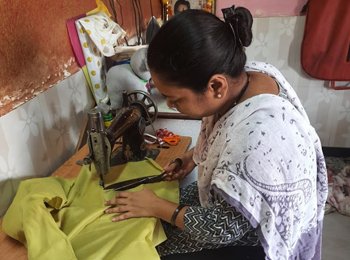
In Mumbai, livelihood trainings are being carried out among 12 SHGs in Govandi and Mankhurd. Despite the economy opening up, many have still not been able to either get their jobs back or restore the wages that they were getting pre-pandemic. The situation is worse for those who lost their sole breadwinners to the virus. Here's a story of 3 women who have been able to make ends meet, thanks to the livelihood training they received. These trainings are being done in collaboration with Siemens.
Read More
10 Mar, 2021
Mayurbhanj, Odisha
Youth Volunteer As Teachers During Pandemic
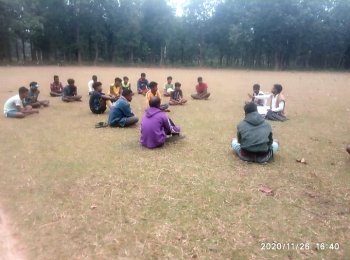
Last year, the sudden lockdown led to the closure of more than a million schools throughout the country leading to disruption in education of school students. While children everywhere faced the impact of this discontinuity of their education, the situation proved to be more severe for children from remote rural areas who had no access to internet, smartphone or electricity to be able to access virtual classes. This problem was further exacerbated for tribal students who further faced the challenge with regard to the language of instruction used for classes that were being broadcast. This situation prompted the Dharamveer Youth Group from Prasan Chandrapur Village of Noto Panchayat to come forward and take the responsibility of supporting children from the community so that they could continue their education.
Read More
14 Feb, 2021
Chhattisgarh & Jharkhand
Solar Boost For Rural Livelihood
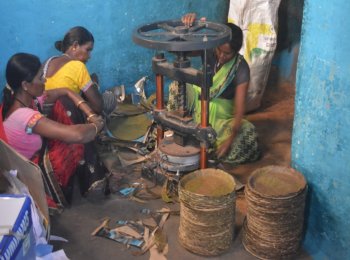
Based on the success of the solar-powered Sal leaf plate making unit in Chhattisgarh, two more machines were installed in Jharkhand and Chhattisgarh. This value addition will improve the quality of the product and fetch better price than the traditional hand-made plates. These have been set up in Bade Gobra village in Mainpur block in Chhattisgarh's Gariaband district and in Mohanpur Village in Sundarpahari Block in Jharkhand's Godda district.
Read More
11 Feb, 2021
Kushinagar, Uttar Pradesh
Making Toilets Sustainable
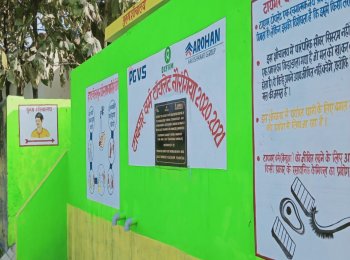
On February 2, 2021, Oxfam India handed over a Tiger Worm Toilet (TWT) complex to the Naurangiya panchayat in Uttar Pradesh’s Kushinagar district. Present at the handing over were community members and representatives from the Arohan Foundation and our on-ground partner PGVS. The toilet complex has five toilets and is built in the complex of the panchayat bhawan.
Read More
