


Early Warning WhatsApp Messages from Bhutan Save Lives in Assam
- By Yahoo News
- 15 Jul, 2019
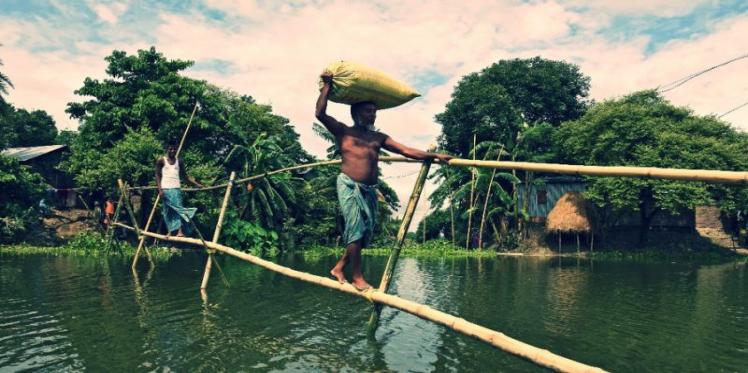
In the last few weeks of June 2019, a series of WhatsApp messages were sent from Bhutan to India to warn “cross-border friends” downstream of the Aai, Saralbhanga and Manas rivers about cloud-bursts, swollen rivers and possible flash floods affecting people in Assam.
Although originating from officials, these messages were not sent via official channels. That would involve the dzongdag – the administrative head of the dzonkhag, or district – in Geluphu passing information to the officials in Bhutan’s capital Thimphu, who would then inform officials in New Delhi.
They would, in turn, inform officials in Guwahati, who would pass the warnings on to Kokrajhar district headquarters. In the final stage, these messages would be relayed from there to villages along the India-Bhutan border.
In most cases this circuitous channel would take too long, with information either critically delayed or unclear, and of little use to most river bank communities in downstream Assam.
Now, though, the communities are relying on these “WhatsApp early warnings” routed through members of Bhutan-India Friendship Association (BIFA) to friends in NGOs like the North East Research & Social Work Networking (NERSWN), who pass the information to their network.
Now, though, the communities are relying on these “WhatsApp early warnings” routed through members of Bhutan-India Friendship Association (BIFA) to friends in NGOs like the North East Research & Social Work Networking (NERSWN), who pass the information to their network.
Messages are forwarded within minutes, giving the villagers precious lead-time to prepare and escape the wrath of the suddenly rising rivers.
“It is difficult to predict when the flash floods will occur. In case of water released from dams the Bhutanese government sends early warning to New Delhi but even then some times, by the time we receive the information and pass it onto villages along the border it is too late. The challenge is lack of communication infrastructure in the area. There are no cell towers on the Indian side and most villagers on the border surreptitiously use Bhutanese SIM cards. Those WhatsApp messages probably save lives of hundreds,” said Kamal Kishor Hazarika, project officer at the District Disaster Management Authority (DDMA) in Kokrajhar.
These small rivers that start in Bhutan or Tibet flow into the transboundary Brahmaputra River in India.
“It’s costly, using internet, but for emergency all the villagers depend on WhatsApp,” agreed Aniram Basumatary of Saralpara village, while speaking to thethirdpole.net. “Communication is important, especially in monsoon season. Anything can happen, and getting advance warning will help us to be ready. We have suffered enough because of lack of warning.”
Decades of militancy in this corner of India has led to a complex situation, where communications infrastructure is seen as both a threat and an opportunity, making it a politically challenging decision to strengthen communications in the area.
The Cost of No Warning
Banglajhora is a small village on the banks of Saralbhanga river in Kokrajhar district of Assam. The village faced three devastating floods in 2012, 2014 and then again in 2016. Since then, every monsoon the fear of floods is palpable among its residents, who belong to the Bodo indigenous community.
Satyaraj Narzary recalled the floods of 16 July 2012, “When I woke up in the morning, there was no water. Nor were there any signs of flood. But around 8 am, the water started rising and before we realised what was happening, the whole area was flooded. About 10-12 houses were washed away. Many families lost their cattle in the floods, their standing crop of paddy was destroyed and considerable amount of land was lost due to erosion. We have not been able to farm on that land ever since.” He said that the floods happened following heavy rains in the foothills of Bhutan when the Saralbhanga river broke a temporary embankment.
In August 2014, Banglajhora was inundated again without warning, when the gushing waters of Saralbhanga eroded the Saralpara-Patgaon bund and several hectares of paddy and private properties in the area were destroyed. The local residents had to take shelter at a relief camp for over a week.
"Nearly 1.8 million were affected due to flood in 22 Assam districts" - The floods of 2016 were the worst. Heavy rains caused flash floods in most of the tributaries of the Brahmaputra. Nearly 1.8 million people were affected in 22 districts across Assam. Lower (western) Assam’s Kokrajhar and Bongaigaon districts were the worst affected, and the villagers of Banglajhora faced the brunt of it all.
“We had to run with our children and the few belongings we were able to gather. One contingent of the Army rescue team was deployed to rescue us with lifeboats but the force of water was such that the first lifeboat turned turtle in the middle of the river and the villagers ended up rescuing the soldiers,” said Kamal Basumatari.
“After that we made a raft with few tyre tubes and bamboo to ferry women, children and a few belongings across the river with great difficulty. I have never seen Saralbhanga so furious. The water was also very cold,” he added.
WhatsApp For Disaster Warning
“Floods, both riverine and flash floods, are the most common hazards in the Hindu Kush Himalayas and account for 17 percent of people killed and 51 percent of the damage. Unlike riverine floods, flash floods occur rapidly with a very short lead time for warning. They can arise following intense rainfall events, or as a result of breaching of natural dams formed by landslides or from glacial lakes formed behind end moraine dams (glacial lake outburst flood or GLOF),” Neera Shreshta Pradhan of the International Centre for Integrated Mountain development told thethirdpole.net.
“In recent years, increasingly erratic and unpredictable monsoon rainfall patterns and increased climate variability have led to severe and frequent flood disasters in the region. There may be some information sharing between governments on major rivers, but tributaries are largely ignored. This is where social relations between transboundary communities are critical for any early warning systems to deliver. Clear and timely communication, proper functional network and preparedness reduces human casualties. Even a short lead time will save lives,” she added.
"“Bhutan is in a high rainfall zone but in the last 15-20 years, there have been more and more cloudbursts, resulting in severe flash floods that destroy everything in their path with alarming regularity in Bhutan and then downriver in Assam. The floods of July 2016 in Saralbhanga river wiped out the entire Sarpang town in South Bhutan before unleashing havoc in Assam. Bhutanese experts have said that this is due to climate change and is in line with IPCC reports.” " - Kripaljyoti Mazumder, state project officer, Assam State Disaster Management Authority
While the Bhutanese have responded by building mitigating structures and preparing their populations, the downstream communities along the border in India can only hope for timely information, seamless evacuation and minimum damage to their homes, cattle and crops.
For this the key elements of disaster risk reduction like risk knowledge, monitoring, analysis, warning generation, dissemination and communication of warning and preparedness for timely response have to work in sync.
"“Getting timely early warning is not enough; the preparedness of the communities is important as well. Already NERSWN has begun a Hazard Risk Vulnerability Assessment (HRVA) mapping of the river basin villages and identified volunteers in all villages to ensure that the early warnings from our friends in Bhutan reach the last mile families, even those who do not have access to WhatsApp or mobile phones.”" - Raju Narzary, NERSWN
“Already this year, the WhatsApp warnings from BIFA to the last mile family has travelled within 10 minutes of being sent out. The delay was due to the fact that the last family ran out of phone batteries, so when we didn’t see the ticks going blue, I borrowed a motorcycle to alert the family. Mobile phones are warning systems but you need motorcycle for sure, as there are always those without mobile phones,” said Aniram Basumatary, who does not own a motorcycle but is saving up for one.
Kokrajhar Call for Action
Building on these relationships between BIFA and NERSWN, 14 civil society organisations from Bhutan and India, including the Bhutan Transparency Initiative and Aaranyak – a leading NGO in Assam – under the stewardship of Oxfam India’s Transboundary Rivers of South Asia (TROSA) programme came together on 20-21 June 2019 in Kokrajhar.
These consultations were designed to strengthen people-to-people ties, and help safeguard the rights of riparian communities upstream and downstream by supporting community-led cross-border ecosystem management and conservation practices.
“The biggest threat to peace is lack of effective management of our water resources, especially along our borders. Some of the poorest people live on transboundary waters of little known tributaries in remote parts of the Indo-Bhutan region, easily the most vulnerable to vagaries of climate change unfolding in these parts. Awareness, empathy, people-to-people networks supported by appropriate technologies, and timely and quality early warning information will go a long way in reducing risks to these communities,” said Pankaj Anand, programme director of Oxfam India, during his inaugural address.
“Early warning is the moral responsibility of people living upstream towards people living downstream. What you are seeing in Kokrajhar district goes beyond the official friendly ties between Bhutan and India. In fact this informal but friendly collaboration for early warning and sharing of our water resources between border communities of Bhutan and Assam is a model for peaceful relationships between countries at a time when peace around the world is threatened by the scarcity of water and climate change induced disasters,” said Kinzang Dorji, who served twice as Prime Minister of Bhutan, and is now the chairperson of the Bhutan Transparency Initiative.
This article was first published on The Thirdpole.net and has been republished with permission. Shailendra Yashwant is a freelance journalist, and this report is part of ongoing documentation by the author of Oxfam India’s Transboundary Rivers of South Asia project in India.
Original article here
More related coverage:
1. Community communications save lives in Assam
2. How WhatsApp messages from Bhutan are saving lives in Assam
3. WhatsApp messages from Bhutan save lives in Assam
4. WhatsApp alerts form Bhutan reach out to Assam
5. Assam-Bhutan build a system of sharing life-saving flood alerts on WhatsApp
6. Monsoon misery: Assams annual tryst with floods
7. South Asia Weekly Report | Volume XII; Issue 27
8. WhatsApp flood alerts from Bhutanese villagers are saving lives in Assam
9. Assam floods: WhatsApp turns saviour for villages along Assam-Bhutan border
10. WhatsApp from Bhutan is saving lives in Assam
11. Friendly social media warnings from Bhutan help Assam villagers tackle floods
12. BBC Hindi
Recent News
Related Stories
18 Mar, 2021
Mumbai
Sewing A Better Future
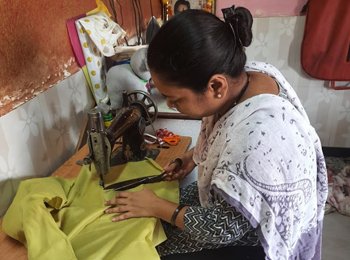
In Mumbai, livelihood trainings are being carried out among 12 SHGs in Govandi and Mankhurd. Despite the economy opening up, many have still not been able to either get their jobs back or restore the wages that they were getting pre-pandemic. The situation is worse for those who lost their sole breadwinners to the virus. Here's a story of 3 women who have been able to make ends meet, thanks to the livelihood training they received. These trainings are being done in collaboration with Siemens.
Read More
10 Mar, 2021
Mayurbhanj, Odisha
Youth Volunteer As Teachers During Pandemic
Last year, the sudden lockdown led to the closure of more than a million schools throughout the country leading to disruption in education of school students. While children everywhere faced the impact of this discontinuity of their education, the situation proved to be more severe for children from remote rural areas who had no access to internet, smartphone or electricity to be able to access virtual classes. This problem was further exacerbated for tribal students who further faced the challenge with regard to the language of instruction used for classes that were being broadcast. This situation prompted the Dharamveer Youth Group from Prasan Chandrapur Village of Noto Panchayat to come forward and take the responsibility of supporting children from the community so that they could continue their education.
Read More
14 Feb, 2021
Chhattisgarh & Jharkhand
Solar Boost For Rural Livelihood
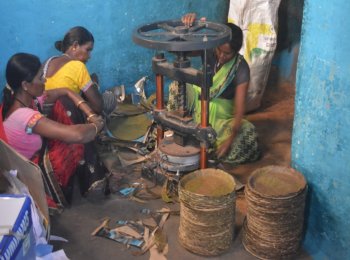
Based on the success of the solar-powered Sal leaf plate making unit in Chhattisgarh, two more machines were installed in Jharkhand and Chhattisgarh. This value addition will improve the quality of the product and fetch better price than the traditional hand-made plates. These have been set up in Bade Gobra village in Mainpur block in Chhattisgarh's Gariaband district and in Mohanpur Village in Sundarpahari Block in Jharkhand's Godda district.
Read More
11 Feb, 2021
Kushinagar, Uttar Pradesh
Making Toilets Sustainable
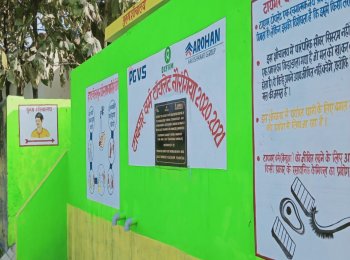
On February 2, 2021, Oxfam India handed over a Tiger Worm Toilet (TWT) complex to the Naurangiya panchayat in Uttar Pradesh’s Kushinagar district. Present at the handing over were community members and representatives from the Arohan Foundation and our on-ground partner PGVS. The toilet complex has five toilets and is built in the complex of the panchayat bhawan.
Read More
